
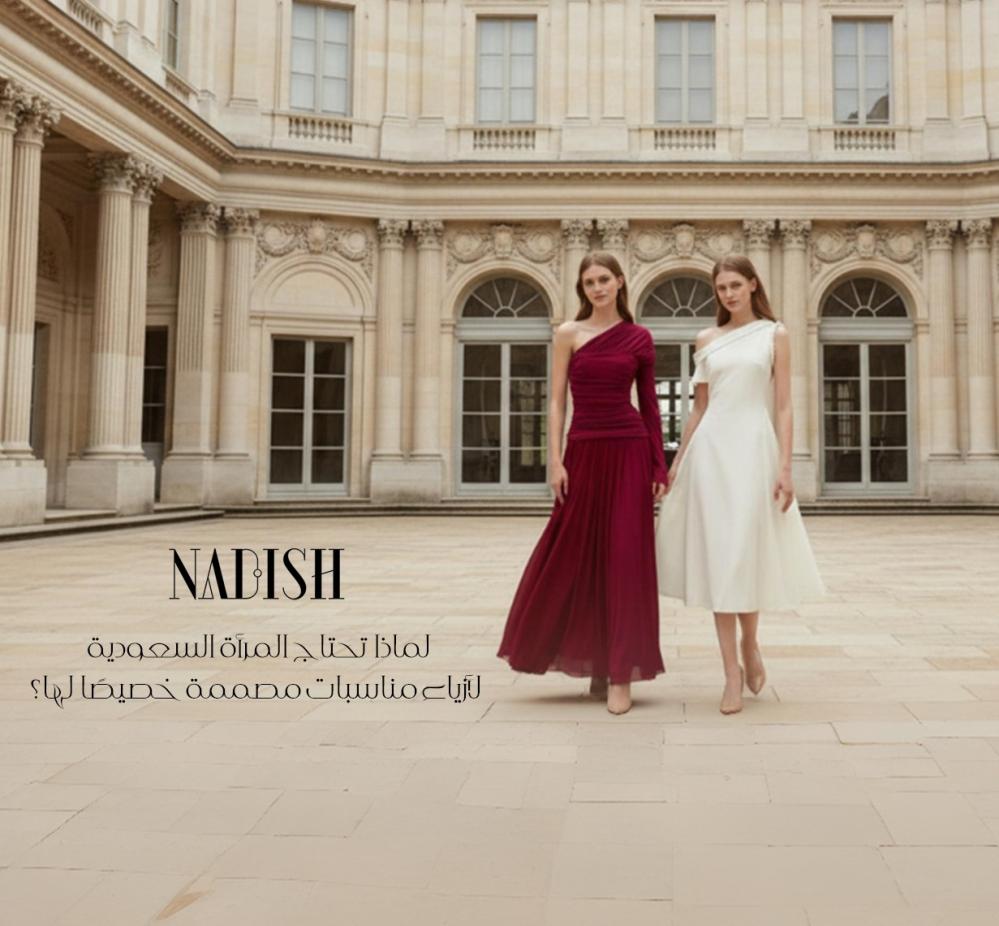
At every Saudi occasion, from weddings to engagements, from formal events to intimate family celebrations, there is a special moment for Saudi women as they choose their dresses. This moment is not simply a matter of selecting fabric and design; it is a complex journey between tradition and modernity, between personal and collective identity, between the desire for distinction and the need for belonging. At the heart of this journey lies a genuine dilemma: how can a Saudi woman find a dress that combines the requirements of modesty and elegance, authenticity and contemporary style, and global design with local sensibilities?
Saudi fashion has always reflected profound social and economic transformations. With the rapid pace of change under Vision 2030, this dilemma has intensified. Today, Saudi women are at the heart of this transformation: educated, ambitious, self-aware, and conscious of their identity, they aspire to represent themselves and their nation in ways that reflect their diversity and strength. In this pursuit, they often encounter a market gap: they either find stunning international designs that don't fully align with their cultural and religious preferences, or they find conservative local fashions that lack high-end design elements and innovation.
This is where specialized brands like Nadish come in, recognizing this gap and taking it upon themselves to fill it. But it goes beyond simply offering "modest dresses" or "Saudi fashion." It's a deeper exploration of a design philosophy that sees the Saudi woman as an intelligent, discerning customer, deserving of tailored options stemming from a genuine understanding of her aesthetic, cultural, and social needs. This article explores the underlying reasons why Saudi women have a pressing need for Saudi fashion designed specifically for them, not as a luxury, but as an expression of their identity and a fundamental right to empowerment.
Chapter One: The Socio-Cultural Context: More Than Just a Piece of Cloth
1.1 The Saudi occasion: A unique social scene
The need for Saudi women to wear appropriately designed clothing cannot be understood without understanding the nature of the "occasion" itself within the Saudi context. Social occasions, especially weddings, are culturally significant spaces. They are not merely gatherings for celebration, but rather spaces for social interaction, for displaying lineage, and for expressing social and economic status. In these spaces, "look" is an essential part of the interaction, and elegance becomes a language that is understood and appreciated.
Saudi events are often segregated by gender, or have women-only sections. This separation creates a safe environment that allows Saudi women to express their style more freely, away from the gaze of foreign men. Consequently, the standards of style revolve around impressing and gaining the admiration of other women, creating a unique dynamic of competition and creativity in selecting appropriate Saudi attire.
1.2 Modesty: An aesthetic framework, not a constraint
In Western discourse, "modesty" is often perceived as a constraint on women's freedom and style. However, in the Saudi context, for the majority of women, modesty is an aesthetic and moral framework deeply rooted in their identity. It is not a lack of elegance, but rather a unique kind of elegance, based on subtlety rather than explicitness, on visual intelligence rather than direct display. Modest dresses do not mean baggy or boring gowns, but rather intelligent designs that respect certain boundaries while innovating in cuts, sleeves, collars, and embroidery, and playing with luxurious fabrics and bold colors.
The need for bespoke designs arises from this: ready-made, international designs are rarely built upon this framework. Dresses may be too short, transparent, or have cuts that don't align with local preferences. Saudi women often find themselves forced to either alter these dresses (which can ruin the original design and cost extra) or compromise on aspects of modesty that are important to them. Bespoke design begins with this framework as a creative foundation, not as an obstacle to be circumvented.
1.3 Identity between the local and the global
Saudi Arabia is undergoing a rapid transformation related to identity. The modern Saudi woman is a product of globalization: she follows global fashion trends through social media, travels abroad, and studies at prestigious universities. At the same time, she is the heir to a rich and profound cultural heritage. Her identity is not a fixed entity, but rather a complex tapestry woven from diverse influences.
This complex identity is clearly evident in clothing. She wants a dress that reflects her awareness of the latest trends in Paris, Milan, and London, but she also wants it to feel connected to her heritage. This might be seen in the use of fabrics like velvet and velour with an oriental flair, in embroidery inspired by Islamic motifs or Bedouin traditions, or even in the choice of specific colors like golden green or turquoise blue. Global ready-to-wear rarely offers this organic blend, while traditional local design may lack the touch of globalization and modernity she seeks. The solution lies in a hybrid design, rooted in local soil yet breathing the air of the world, which is precisely what brands like Nadish, who understand this equation, offer.
Chapter Two: Practical Challenges: The Journey to Find the Perfect Dress
2.1 The Dilemma of Sizes and Adjustments
One of the most frustrating challenges for Saudi women when searching for a dress for an occasion is the dilemma of sizing. Most international designs are based on Western "model" measurements, which differ significantly from the proportions of many Saudi women's bodies. A dress might be too tight at the shoulders or bust, too long, or disproportionate to the waistline. This necessitates costly and lengthy alterations, and sometimes these alterations may not even be possible without compromising the original design.
Designs tailored specifically for Saudi women take into account the diversity of their body shapes. They understand the variations in height, shoulder width, bust, and hips. When a dress is designed with these characteristics in mind from the outset, it fits the body better, and the wearer feels comfortable and confident—two essential elements of true Saudi women's elegance.
2.2 Scarcity of creative options within the "modest" range
In traditional local markets, modest Saudi fashion options are often limited and repetitive. Certain designs are dominated by similar styles, with only slight variations in color or fabric. This creates a sense of uniformity at formal events, something many women try to avoid. Elegance is about individuality and expressing one's personality, not about conforming to the crowd.
On the other hand, when a woman turns to international designers, she faces the opposite problem: an overwhelming abundance of creativity, but most of it outside the realm of what she feels comfortable with. The real challenge is finding a brand that innovates within the bounds of modesty, pushing the limits of design without overstepping them. This could involve offering innovative sleeves, unconventional combinations of materials, or clever geometric cuts that elegantly drape the body. This kind of targeted creativity is what the Saudi market needs.
2.3 Quality vs. Price
Another aspect of the challenge lies in balancing quality and price. A formal dress is a significant investment for Saudi women. They seek high-quality fabrics, meticulous tailoring, and exquisite embroidery and detailing. Often, they find that good-quality local dresses are disproportionately expensive for their design, or that internationally available dresses with acceptable designs are prohibitively expensive due to the designer's name and import fees.
This is where the opportunity lies for niche brands: to offer genuine value. Value that doesn't just come from using luxurious materials and meticulous craftsmanship, but from intelligent design that fulfills a real need. When a Saudi woman buys a dress from a brand like Nadish, she's not just paying for the fabric and threads, but for years of cultural understanding, research into the needs of the Saudi body, and innovation within the framework valued by society. This is a value that's difficult to measure, but the wearer feels it when she receives genuine compliments at an event and feels that the dress perfectly represents her.
Chapter Three: Empowerment and Confidence: The Psychological Philosophy of Appropriate Dress
3.1 Clothing as a psychological shield
The renowned author Virginia Woolf wrote, "Clothing has a tremendous effect on how we see ourselves and how we see the world." This statement applies strongly to formal attire. At social events, where a woman is under the scrutiny of others, a dress becomes a psychological shield. The right dress—one that fits the body perfectly, respects the wearer's values, and combines beauty with modesty—instills tremendous confidence. This confidence is reflected in one's gait, smile, and interactions with others.
When a woman is forced to wear a dress that doesn't fully represent her—whether because it's too tight, too short, or simply doesn't reflect her true style—she loses a part of her shield. She feels insecure and becomes more anxious about her appearance throughout the night. A tailored dress eliminates this anxiety at its root. It's made for you, to resemble you, to enhance your strengths and conceal what you wish to hide. This isn't a luxury; it's an investment in your psychological and social well-being.
3.2 Self-expression and individuality
Saudi women today are not carbon copies of their mothers or grandmothers. Each has her own personality, profession, interests, and unique story. Clothing is one of the most important tools for telling this story. The female doctor, the director, the entrepreneur, the artist—each wants her dress to say something about her professional and personal identity.
Limited or curated options don't allow for this precise expression. But when you have a brand that understands these different layers of identity and offers a diverse range of designs that tell different stories—from majestic classics to bold moderns, from heritage-inspired to cross-cultural—you give women the tools to express themselves in all their dimensions. This is a form of empowerment: being able to define yourself to the world through what you wear.
3.3 Building a collective awareness of Saudi style
When distinctive brands emerge that focus on the elegance of Saudi women, they don't just serve individuals, but contribute to building a collective consciousness. They show the world that "modest elegance" is not a contradiction, but rather a distinct design school with its own principles and aesthetics. This strengthens Saudi women's confidence in their taste and cultural identity. Instead of viewing local preferences as "backward" compared to global fashion, they begin to see them as a conscious and beautiful choice.
This collective awareness is shaped by images these brands share on social media, by Saudi celebrities appearing at formal events in locally designed dresses, and by the public discourse sparked by the brands' success. Saudi fashion becomes a symbol of national confidence and cultural distinctiveness.
Chapter Four: Nadish: A Case Study in Bridging the Gap
4.1 Nadish Philosophy: Understanding Before Design
Nadish is not just another fashion house. Its launch stemmed from the gap we've discussed throughout this article. Its philosophy is based on a deep understanding of the Saudi woman: her physical needs, her aesthetic aspirations, and her cultural connections. It doesn't impose a Western design vision, nor does it simply replicate traditional models without development. Instead, it begins with a dialogue with its target client.
This understanding translates into practical details: cuts that take into account the diversity of Saudi sizes, innovative sleeves that provide elegant coverage without feeling heavy, fabrics suitable for the climate and occasion, and colors ranging from serene, natural hues inspired by the Kingdom's landscape to bold colors that reflect the confidence of the new generation. Nadish understands that Saudi women seek balance: a dress that will be admired at a friend's wedding, while also being comfortable and appropriate for their needs.
4.2 Innovation within the framework
What distinguishes Nadish is its ability to innovate within the framework of Saudi modesty and elegance. Looking at its collections, you'll find a clever play of layers, where sheer and opaque fabrics intertwine artistically. You'll find sculptural details on the fabric that give the dress a three-dimensional feel without the need for tight cuts. You'll find embroidery inspired by heritage but executed with a contemporary touch. This departure from traditional style is the essence of "bespoke design." It doesn't say, "This is what's available globally, take it or leave it," but rather, "This is what we created for you, based on who you are."
This approach liberates creativity. The designer here is not constrained, but rather guided. The challenge becomes even more exciting: how do you create a breathtaking dress without revealing anything? How do you create a dramatic effect using sleeves and back instead of the chest and legs? Nadish's answers to these questions are what make it a leading brand.
4.3 Customer experience that goes beyond the purchase process
Nadish understands that the search for the perfect dress is an emotional experience. Therefore, she strives to build a complete customer experience. This begins with an attractive and easy-to-navigate website, where her philosophy can be explored through collections such as those showcased in her high-end modest fashion range , and continues with a personal consultation service that helps the customer choose what suits her body shape, skin tone, and personality, all the way to meticulous attention to detail in packaging and delivery.
This experience builds trust and a long-term relationship. A woman isn't just buying a dress; she's embracing a brand she understands. Nadish becomes the first choice when a suitable invitation comes in. This trust is the true capital of any brand in this sensitive field.
Chapter Five: Future Outlook: Towards a National Fashion Industry
5.1 Empowering local talent
The success of brands like Nadish not only benefits the consumer but also opens the door to an entire creative economy. It encourages the emergence of Saudi designers, both men and women, who study and train locally and internationally, then return to present their vision for Saudi women. This creates a national haute couture industry, generating employment opportunities in design, sewing, embroidery, marketing, and sales.
This industry has high added value because it is based on deep cultural knowledge that foreign designers cannot easily import. Vision 2030 aims to diversify the economy and empower creative sectors, and a sophisticated, modest Saudi fashion industry is a strong candidate to be one of the pillars of this diversification.
5.2 Introducing the world to Saudi elegance
The Kingdom is in the global spotlight today more than ever before. Tourism is booming, international events are being hosted, and Saudi celebrities are making their mark on the world stage. At every juncture, clothing speaks volumes. When the Kingdom's ambassadors—artists, intellectuals, and entrepreneurs—choose to wear Saudi designs like those offered by Nadish, they not only showcase their personal style but also present a modern and sophisticated image of Saudi fashion to the world.
This cultural export through fashion has a long-term impact. It breaks stereotypes, showcases Saudi creative potential, and draws the fashion world's attention to a new creative hub that may be different from traditional centers, but is rich and exciting.
5.3 Evolution alongside the evolution of society
The needs of Saudi women are not static. As society perceives it, notions of elegance, modesty, and personal expression are evolving. Successful brands are those that maintain a constant dialogue with their community. Nadish, through its constantly renewed collections such as the recent occasion wear collection , demonstrates this capacity for evolution. In the future, we may see designs that cater to the needs of working women for formal business occasions, or the increasingly popular trend of smaller, more intimate Saudi attire, or even collaborations with Saudi female artists to integrate visual art into design.
Flexibility and understanding are key. The future holds more diversity within Saudi society itself, and the brand that can serve this diversity within its philosophical framework is the one that will survive and thrive.
In conclusion: The dress as a personal and social statement
Saudi women don't need specially designed occasion wear simply because their options are limited, but because their identity is rich and complex and deserves accurate representation. Their bodies have unique characteristics that warrant attention. And their self-confidence when standing at a social event deserves to be built on a solid foundation of comfort and satisfaction.
The demand for these fashions is, at its core, a demand for recognition. Recognition of the Saudi market as an independent entity with its own tastes and needs. Recognition of the Saudi woman as a conscious consumer capable of defining her own preferences. And recognition that "fashion" is not a monolithic global system, but rather a dialogue between cultures, where a framework of modesty can produce an elegance that inspires the entire world.
When a Saudi woman chooses a dress from a brand like Nadish, she's not just buying a beautiful piece of fabric. She's endorsing a design philosophy she respects. She's investing in her self-confidence. And she's contributing, even in a small way, to shaping a new visual identity for Saudi women: confident, rooted, and forward-looking.
Discover Nadish's philosophy, which places you at the heart of the design process, offering options that reflect who you are in every dimension. From majestic classics to bold, modern designs, explore a world of tailor-made elegance by visiting their ever-evolving collections, such as their elegant long-sleeved dresses . Because every occasion deserves an unforgettable dress, and every woman deserves a dress unlike any other.